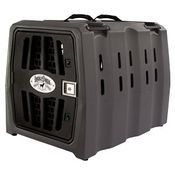
Super Insulated: 27% more insulation that any other manufactured dog house. K-9 Kondo puts more insulation where it's most needed, in the ceiling -- one full inch of insulating foam. Walls and floor are 3/4 inch foam sandwiched between exterior metal and interior plastic layers.
UV Protected Metal Exterior Walls and Plastic Interior: The UV protected exterior will protect your dog for years. Nothing to rot and it's easy to clean and disinfect.
Removable Lid: The lid removes easily for cleaning and to change bedding.
Chew Proof: Your dog cannot chew this dog house.
Roomy: The Dog Den I measures 34" long x 22" wide x 22" high.
4 1/2 Inch Door Lip: Keeps bedding inside better than any competitor.
Popular "Kennel Door": Swings both ways and locks open for summer ventilation. No chewable flaps that channel water inside. Even stops wind driven rain!
Strong and Lightweight: The most abusive dog can't hurt the Dog Den 1.
5-Year Manufacturer Guarantee: K-9 Kondo will replace any part that fails due to defect or chewing for 5 years from time of purchase.
Assembly Required. Allow 2-3 hours assembly time.
A Rivet Gun which can be purchased at most hardware stores for $10-$20 is required.
The optional support frame requires one treated 2 X 4 - not included.
PLEASE NOTE: Allow 2-3 hours for assembly of kit. If you are not comfortable in your ability to assemble please consider purchasing the Dog Den II instead. Returns on partially assembled kits cannot be accepted.
Use gloves and eye protection during assembly.
Assembly Instructions:
Step 1 -- Construct a support frame from pressure treated 2 x 4 lumber as shown in fig. 1. (C = 21.75" B = 26.75" A= 17.75"-part A is on the door side.) Use a screwdriver to lift the five (some models have 6) metal floor tabs to form a right angle with the floor. Attach parts A & C to the floor by inserting one of the 14 sheet metal screws through each tab into the wood as shown in fig. 1. Insert one deck screw through parts C & A into part B. Attach the chew guards to the ends of the 2 x 4 lumber using two sheet metal screws on each chew guard as shown in fig. 3. Do not over tighten.
Step 2 -- Reverse roll the plastic inside wall liner in order to straighten it. Another method is to unroll the plastic and lay it flat in a heated room or in direct sunlight for several hours.
Step 3 -- All wall panels attach to the outside of the floor tabs. The edge of the panel should be flush with the floor. If not, the wall panel is upside down. Align the pre-punched holes of the left wall panel (has a radius corner on each end) with those on the left tab. Attach the panel to the tab with one rivet in the center hole. Align the remaining pre-punched holes in the wall and floor and reem with a 9/64 bit and attach with rivets. Do this step on all pre-punched holes to insure the best possible fit. Attach the wall panel to the floor tab with rivets.
Step 4 -- Attach the right wall panel to the tab with one rivet in the center hole. Align the punched holes of the right wall panel with those on the right floor tab. Reem each hole with a 9/64" bit and fasten with rivets. See fig. 2.
Step 5 -- Insert the edge of the back wall panel fully into the groove of the right and left wall panel. The panel has a notch on each bottom corner which faces inside the floor. If the groove is too tight, use a screw driver to widen the groove by inserting the tool's wedge along the length of the groove in several places. Align the pre-punched holes of the back panel with the floor tabs, beginning with the center hole, and attach with rivets. Attach the front panel in the same manner as shown in fig. 3.
Step 6 -- Align the pre-punched holes of the door plate, front wall panel, right wall panel, and liner stops (front liner stop is attached). The door plate overlaps the front panel. The rivets connect the door plate, front wall panel, right wall panel, and liner stops shown in fig. 4 & 5.
Step 7 -- Make sure that the edge of the panels are pressed fully into the groves of the front and back panel. Drill a 9/64" hole through each panel grove and wall panel approximately six inches from the top edge of the walls as marked by the XX (this step has been done at the factory). Fasten with rivets. This keeps the walls in place when inserting the insulation and prevents the top from being wider than the bottom. See fig.6.
Step 8 -- Pre-bend the insulation so that it conforms to the contour of the corners as shown in fig. 7. Position the wall insulation so that the end of a piece does not stop in a corner. Slide the edge of the wall insulating foam into the liner stop as shown in fig. 8a.and push it down until it is flush with the floor. Complete this step with the other part of the wall insulation. Trim the insulation that extends past the top of the wall.
Step 9 -- Bend the ends of the wall insulation so that the edges meet as shown in fig. 8b. Push the insulation towards the back wall so that it will push out sideward and conform to the wall's shape.
Step 10 -- Slide the edge of the inside plastic wall's ends into the liner stops and install as shown in fig.7.
Step 11 -- Invert the steel inside floor and place the pre-cut 3/4 inch insulation within its rim. Insert the steel floor with the steel side up. Push the floor down until it rests evenly on the floor. Note: The floor can be easily removed for cleaning.
Step 12 -- The wall supports come in four lengths. Looking at the ends you can see that one side is longer. The short side attaches to the outside of the wall. The right wall support measures 18 7/8" length and has a notch on one end which faces the right front corner. The front support measures 30 7/8 ". The left support is 16 3/4" with the back wall support at 28 1/4".
Step 13 -- Install the right wall support with its end near the corner overlapping the corner support. With the short bend on the outside, align the holes and attach with rivets. The last hole on each end of the support must be drilled and riveted. Do not drill holes in the liner yet. Install the corner supports. Install the back and left wall supports using the same procedure as used on the right support. See fig. 8, 9 & 10.
Step 14 -- Install the front wall support with the right half of its length placed between the front wall and door plate. Align the pre-punched holes of the wall and wall support and attach with rivets. Drill and attach with rivets at the five "X's on the front wall support as shown in Fig. 10.
Step 15 -- Make sure that the inside wall is tight against the insulation. Drill and rivet the remaining wall supports to the liner and inside metal corners. Pressing the ends of the supports tightly against the liner with pliers or other clamping tool will ensure a snug fit. Drill and attach the liner stops to the inside wall.
Step 16 -- Peel off the paper from the weather stripping as you push the adhesive side of the weather stripping to the top of the wall supports.
Step 17 -- Attach the door/cowl assembly to the front side of the door plate with ten # 10 x 32 x 3/8" machine bolts, lock washers and nut. Do not fully tighten bolts. Insure that the door swings freely without striking the door plate before full tightening. If the door strikes the door plate on the right raise the left side of the assembly. If it strikes on the left raise the right side. APPLY SILICONE LUBRICANT BETWEEN THE HINGE PIN AND RUBBER BUSHING WEEKLY. REPEAT THIS STEP MORE OFTEN IF THE DOOR RECEIVES HEAVY USE. See fig 11.
Step 18 -- Place the lid on the Dog Den. Allow the latch to hang from the latch strike that is attached to the left and right sides of the lid. Mark the location of the bottom hole of the latch on the wall with an ink pen or pencil. Attach the latch to the wall by inserting one small self tapping screw in the bottom hole at the spot marked. Insert one small self tapping screw into the top hole. See fig. 12.
Note -- The rubber door bushings are a consumable part, much like tires on an automobile that is not covered under the manufacturer's warranty. Lubricate them often with silicone lubricant to increase serviceability.
Use high quality grass hay for bedding (prairie, marsh, timothy, or brome grass hay). Do not use pillows or blankets as they can jamb the door and prevent the dog from getting out. Wood chips; straw, clover, and alfalfa are poor bedding alternatives. Change bedding often.