|   ARTICLE: Bird Dogs and Radio Tracking Q&A -- Ken Barber, President of Tracker Radioby Ken Barber, President of Tracker Radio
-- Bird Dogs and radio tracking Q&A
Q: What is Radio Tracking?
A: It is method for sending data by employing one or two-way radio
signals. Other terms for radio tracking common for some applications
include radio-direction finding (RF), radiolocation and telemetry.
Q: How is radio tracking used with pointing dogs?
A: radio tracking is used to locate bird dogs (primarily the pointing
variety) in the field both as a means of recovering a dog that is lost
as well as an aid in hunting. Until recently, radio tracking was
primary used with field trial dogs that tend to range a significant
distance from the handler. The use of radio tracking has dramatically
reduced the incidence of lost dogs at these events. Recent advances
in microelectronic design have allowed miniaturization of the
equipment to allow it to be readily employed by foot hunters in the
field.
Q: How does the technology work?
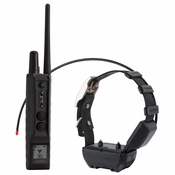
A: There are two components to a radio tracking system - a
transmitter and a receiver. The transmitter is attached to a collar
worn by the dog. Most bird dog transmitters are relatively small
(less than 6 ounces) and many utilize commercially available
batteries. The transmitters emit a signal on a specific frequency
that can be monitored by a receiver. The receiver, carried by the
handler, is a small radio-like device fitted with a special
directional antenna. The directional antenna is utilized to receive
the radio waves emitted by the transmitter and input this into the
receiver. The receiver then interprets the signal strength and
displaying the data in the form of a needle, row of LEDs or LCD
display often in conjunction with an audio speaker. By taking a
reading (sweeping the antenna in a 360-degree arc) the direction of
strongest signal can be determined thereby indicating the bearing to
the dog.
Most transmitters used with dogs employ a short pulse (7 milliseconds)
at a rate of 1 pulse per second. Many systems also feature a
behavioral circuit (motion sensor) that indicated that the dog is
stationary (on point). The "point" signal is generally indicated by
doubling the frequency of the beeps (2 per second) after a short (3 to
10 second) delay. Some systems also feature a unique signal for low
transmitter battery and a pulse code that differentiates collars
operating on similar frequencies.
Q: What are other uses of this technology?
A: There have been many uses of radio tracking over the past century.
Radio-direction finding was employed in WWII to pinpoint location of
distress signals and track German U-boats in the Atlantic. Following
WWII, radio tracking has been extensively employed to track animals in
the wild throughout the world. From elephants to fish to various bird
species, telemetry is still the preeminent method for locating
animals. Moreover, radio tracking is very popular with falconers and
hound hunters throughout the world. Other uses include location of
downed aircraft (Emergency Location Transmitters), lost hikers
(Personal Location Beacons) and boats/ships in distress. One reason
for its popularity is that fact that the transmitter/receiver pair
makes up a complete system not requiring any additional
infrastructure.
Q: What have people used to locate a pointing dog before radio tracking?
A: For years, hunters have used various methods to locate their
hunting companion. Most employed nothing until the dog became lost.
At that point, they shot in the air, drove roadways in the vicinity of
the last sighting, waited for an honest person to call if the dog's
collar had a name plate attached or put up "Lost Dog" signs. These
procedures were generally ineffective and many a dog remained lost
forever. The first devices attached to the dog were bells (attached
to the collar) that would indicate position of the dog until it went
on point. Bells were simple to employ and reliable but were of
limited value as distance between the handler and the dog increased.
Moreover, a bell is of no value for locating a dog on-point, as the
bell is silent when dog is motionless.
In the last two-decades, beeper collars have effectively replaced
bells as the most popular in-field pointing dog locator. Early
beepers were switched on at the beginning of the hunt and switched off
at the end of the hunt. Many models varied the tone or the frequency
of tones depending whether the dog was running or stationary. In the
1990's several manufacturers offered beepers in conjunction with an
electronic training collar as well as beepers that would accept a
remote command (turn on, turn off, reprogram features, call command,
etc.). Beepers increased the effective distance for locating the dog
and were useful in locating a dog on point. Key drawbacks include the
effect of the sound on the dog's hearing and the negative effect of
the electronic noise to the hunting experience. While the effective
distance increased over bells, locating a beeper collar on a windy day
or in steep terrain was still a challenge. Many handlers reported
poor results using beepers as they believed that the sound encouraged
the dogs to break point in order to turn off or lessen the frequency
of the noise.
Q: Who should own a radio tracking system?
A: Outside of avid field trailers who have employed tracking systems
as essential gear for training and handling field trial dogs, many
wait to purchase a tracking system following the loss of a dog. As
receiver/antenna size and system price continue to decrease, many
hunters have upgraded to the technology. Currently, high-quality
tracking equipment costs about the same as a good 2 dog electric
training collar and receivers can be easily carried in the field.
Experienced users cite the value of knowing that they will be in
constant contact with their dog while hunting and able to instantly
tell whether the dog is on point or running.
Q: What if my dog does not range a great distance, do I still need a
tracking system?
A: A tracking system is an item that you will use for many years
spanning life of your dog. Many puppies run off and get lost
(exploring, chasing deer and rabbits, etc.) as they learn the world
around them. In addition, older dogs, particularly those that are
deaf or have limited hearing, can become disoriented and unable to
locate the handler. If you hunt in dense cover and/or in difficult
terrain, a tracking system can be very helpful in finding a dog on
point without having to employ noisy hard-to-locate beepers. In
addition, some dogs can become entangled or trapped (fall into hole,
cave) and are unable to return to the handler.
Q: In addition to locating your hunting dog, are there other benefits
to owning a tracking system?
A: One key benefit is quickly determining whether the dog is on
point. The receiver can be turned on and if the collar features a
point mode, the handler can know within seconds if the dog is running
or pointing. If the dog is running and the handler wants to call the
dog back, he does so knowing that the dog is not on point. Some
professionals suggest that a dog is more likely to hold point for an
extended period of time after some experience with tracking systems.
The tracking system allows the handler to quickly find the dog on
point and after being rewarded with retrieves, dogs often will wait
more patiently for the handler to show up. Additionally, dogs are not
annoyed by loud beepers, handlers blowing a whistle or calling when
oblivious to the fact that the dog is, in fact, on point.
A secondary benefit for systems capable or tracking several
transmitters is leaving an active transmitter in the vehicle to aid in
finding one's way back. This is particularly useful when hunting in
new territory, when inclement weather conditions (fog or heavy snow)
prevail or if the handler does not own a GPS system.
Q: What is the range of a tracking system for pointing dogs?
A: The major factors determining range of radio tracking systems are
the power of the transmitter and topography. Most transmitters
employed on pointing dogs can be detected over a flat unobstructed
plain (line-of-sight) for 12 miles or more. Range can be reduced
based on steep, rugged terrain when the signal is not line-of-sight.
In some cases the effective distance can be reduced to less than a
mile based on a weak collar and difficult conditions (transmitter and
receiver both in depressions separated by a high ridge). Minor
factors include thick, wet vegetation and atmospheric (high humidity)
conditions which tend to attenuate (weaken) the signal. Nevertheless,
for the most part, few pointing dog trackers are ever out of contact
with their dogs.
Q: If this technology has been utilized for many years, why have
tracking systems for pointing dogs only becoming popular for the
hunter in the last decade?
A: Primary reasons are receiver size (portability), ease of use and
cost. A decade ago, there were few models that could be carried in
the field. Most receivers of this vintage remained in the vehicle and
were only utilized once the dog became lost. Recent advanced in
microelectronic design have dramatically reduced the size of receivers
and made them much easier to operate. These innovations have allowed
these systems to dramatically add value to the hunter by allowing him
to keep track of his pointing dog at greater distances than other
technologies and quickly locate a dog on point.
Q: Won't GPS/cellular systems eventually replace radio tracking?
A: It is true that the ability to send location coordinates from the
dog to the handler can greatly aid in tracking and these systems are
becoming more available throughout the world. Nevertheless, GPS
systems require visibility to the sky and may not be able to receive
location data from satellites under heavy tree cover or in deep
ravines. The carrier for the GPS location data is most often digital
cellular and coverage in remote areas (hunting areas) is often
lacking. Satellite communications, while exhibiting excellent
coverage, requires higher power (large transmitters) and are probably
not applicable in tracking dogs. Another disadvantage to
GPS/Cellular systems is latency. The traditional telemetry system
instantly detects the signal from the transmitter once the receiver is
switched on. A GPS system requires an initialization phase to acquire
the satellites and the cellular communications sometimes takes several
seconds to a minute to transfer the data. This can result in a
location sequence taking a minute or more. Additionally, GPS units
typically have high power requirements and battery life may be a
limitation.
A chart comparing the various technologies used in locating dogs is
presented below:
Bell Beeper Tracking system GPS/Cellular
Effective distance 100-200 yards 100-400 yards 1 to 12 miles depending
on topography unlimited
Indicates point & run No Generally yes Generally yes An option
Portability of equipment Excellent Good Some good some too large to
carry in field Good
Latency Instantaneous Instantaneous Instantaneous 30 sec to 2 minutes
Cost Less than $25 $70 to $700 (if combined with e-collar) $600 to $1200 $1200+
Required infrastructure None Self-contained Self-contained Access to
satellites and digital cell coverage required
Operating cost none Batteries for most beepers Batteries for receiver
and transmitters Cellular account eventual replacement of rechargeable
batteries
Ease of operation Simple Relatively simple Requires some
practice Learning commands and configuration settings can be complex
Attached to dog Collar Collar Collar Special vest with pocket for
GPS/Cellphone unit
Q: Are radio tracking systems difficult to operate?
A: For those with no experience with tracking systems, some practice
is required to become proficient in operating the receiver and
interpreting the signal. Experienced radio trackers should also
practice with a new system as each model has its own set of unique
operating parameters. The key objective of training is understanding
the operation of the receiver before attempting to locate a dog in the
field on a hunting trip. It is best to start by locating a
stationary transmitter (collar hung from a tree limb by a family
member) in a flat area with few obstructions. After several
successful transmitter "finds," set up a similar practice situation in
an area similar to your hunting area. After you have successfully
located several collars in different types of topography, you are
ready to use the system in the field. It is important to note that
those that spend a short time learning how to use the equipment
quickly become proficient in using the system in the field. The
system is very reliable and proficient users rarely, if ever, are
unsuccessful in locating a transmitter.
Q: What problems are most often encountered by new users?
A: Many of us are impatient and take insufficient time to learn how
to operate new equipment. New users sometimes become frustrated if
they do not learn the operation of the receiver before going in the
field with their dog.
There are three common challenges for new users: 1) appropriate
setting of the gain level, 2) "listening" from a bad location and 3)
understanding reflection commonly referred to as following the back
signal. The gain setting on most receivers can be set by the user.
Gain is the sensitivity of the receiver to the signal and should be
set as low as possible where an audible beep can be heard. An
inappropriate high gain setting will yield a strong signal in all
directions. By reducing the gain, a strong signal should be reduced
to only one direction.
It is important to learn what types of locations work best for
"listening" for the transmitter. A transmitter that is situated in a
line-of-sight position to the receiver will be much easier to track
than one that is located behind obstructions. Therefore, listening
from a ridge top is advisable to a topographical depression. An
experienced radio tracker can identify the ideal locations to obtain a
bearing and will take several readings from different locations if the
signal is not easily interpreted.
Most higher quality antennas are designed to differentiate between the
true signal and the signal 180 degrees from the true bearing (commonly
called the back signal). Generally, with a little practice, a radio
tracker can differentiate between the two by setting the gain at an
appropriate level. Other tricks used by professional trackers include
periodically checking the back signal to assure that they are tracking
the true signal or using triangulation from separate points to
determine the correct bearing.
|
Before you decide which collar to buy, read our Dog Training Collars guide for dog product comparisons, features, reviews, & more information. Trouble with a barking dog? Steve loves his Tri-Tronics no bark collar. Check it out!

Order online via Secure Server or call
1-800-624-6378
GUN DOG SUPPLY- "Serving Hunting & Field Dog Owners Nationally Since 1972."
All words & pictures are copyright (c) 1997-2009, Gun Dog Supply or their respective owners. All rights reserved.
By Yahoo Store designer. Buy online with confidence when you order discount retriever hunting dog supplies, canine training equipment, k-9 accessories, and training products for your gun dog, bird dog, or working retriever. Your on-line purchase is protected through secure server ordering. Review our 100% satisfaction guarantee. Shop our canine closeout items, best bargains, k9 discount prices, good deals, cheap stuff and other values for sale. Compare our products in reviews, reports, comparisons, reports, and buyers guides. See our Retriever Training dummies.
|
|