Put This on Your Dog's ID Tag to Almost Guarantee They Get HomeBy Steve Snell, Gun Dog Supply Your phone numbers.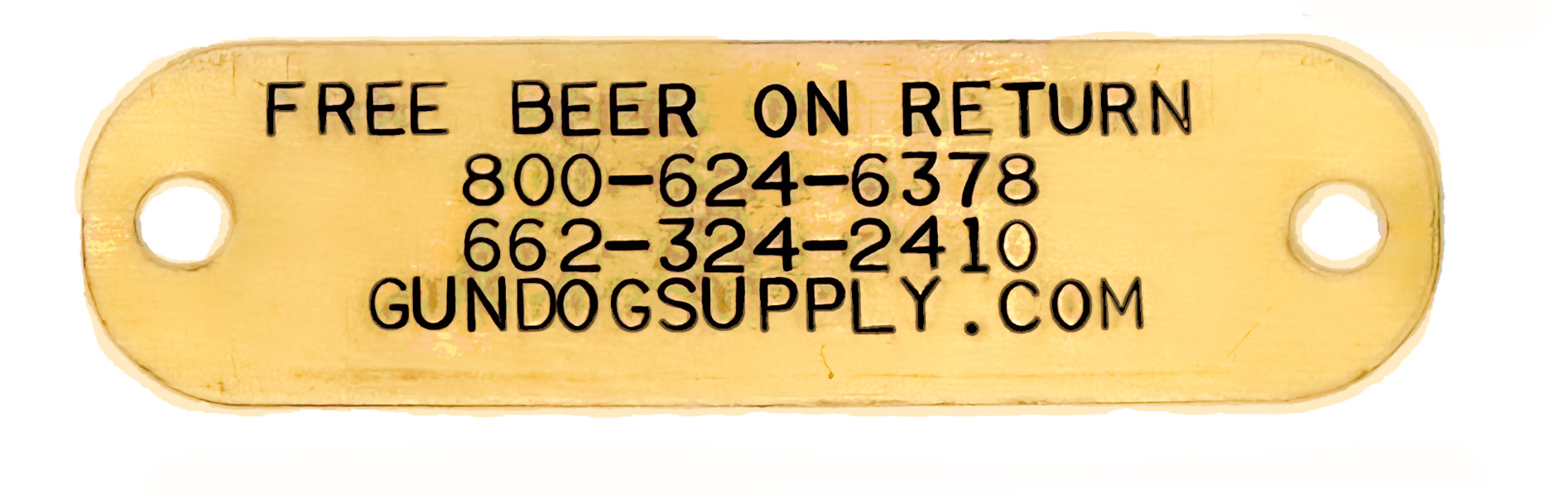
That's it. That's the whole article. If you want to stop reading right now and go order a collar with a free name tag, I understand completely. But if you want to know why, and how, and hear a few stories that will make you go find your dog's collar right now and check what's on it — keep reading. Dog Tags: The Original Dog Recovery DeviceWe sell GPS dog tracking systems and LTE tracking collars. I believe in all of it. But when you strip everything away, the dog ID tag is the original dog recovery device. It's the thing that works when the battery is dead, when you're out of GPS collar range, when the worst possible thing has already happened. I've had it save dogs more times than I can count. Some of those times, I didn't even know the dog was gone. Bit — one of my early dogs, black and white and ticked — got out without me knowing. Phone rings. Guy says: "I've got your dog. Little black dog." I said, she's not black, are you sure? He said, "Well, she's got a collar with your phone number on it." She was right around the block. I had no idea she'd gotten out. Em — one of the best bird dogs I've ever owned — was deathly afraid of thunder. She'd rip through metal to get out of a kennel run during a storm. One night around ten o'clock she broke out and ran two miles down the state highway we live on before stopping at somebody's house. I was asleep. Guy called and said he had my dog. Tag. Phone number. Cowboy — my English Better — when my oldest son Sam was studying at dog training school and had Cowboy with him, we changed the collar plate to Sam's number. Storm came. Cowboy busted out of a kennel. Sam gets a call — somebody found him. Same story, different dog, different decade. Jack — twelve-year-old English pointer, recovering from skin cancer surgery, wearing a cone — somehow pushed out of his wire crate, squeezed through a cat door in my garage, and disappeared for most of a Saturday morning. He wandered back to the kennel on his own about five or six hours later, no worse for it. But he had his name and number on him. Had somebody found him first, they would have called me. And then there's Maggie. Maggie was a little Brittany my father took in because he had a soft spot for dogs people had given up on. Gentlest, closest-working dog you ever saw — never got more than thirty yards from us in five years of hunting. Didn't think she needed a beeper collar. One day in Texas, a big running dog went on point three hundred yards out and we all went to it. When we looked around thirty minutes later, Maggie was gone. We spent four days looking for her across eight hundred miles of Texas ranch country. Found her fifteen miles away, four days later — same hotel, different hunters had her. She was fine. Lucky. 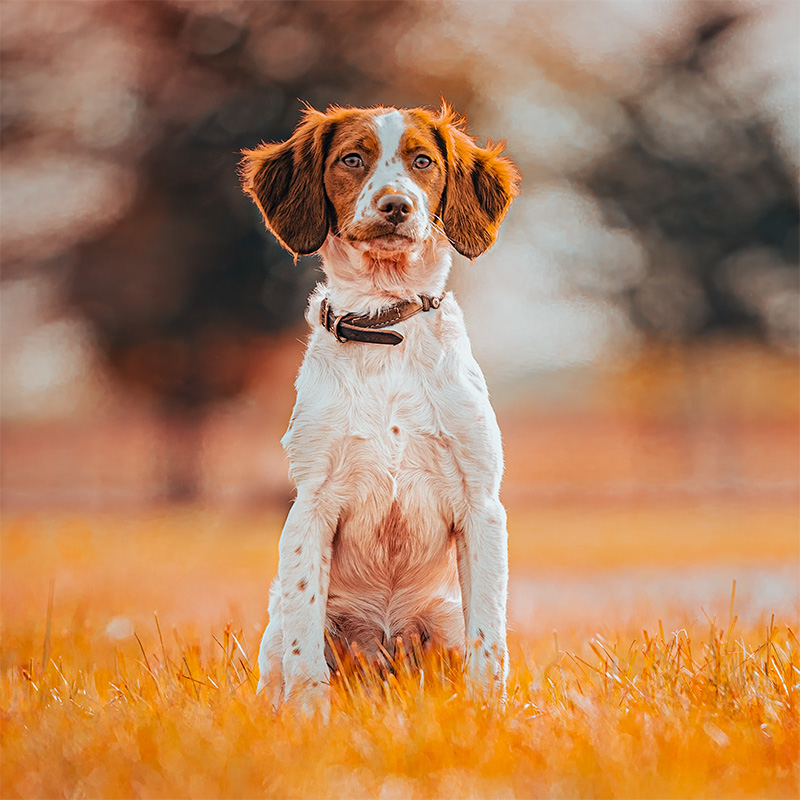
Losing Maggie is what pushed us into radio telemetry dog tracking. And the whole point of the story is this: just because a dog has never gotten lost doesn't mean she won't. Puppies, old dogs, homebodies, field dogs. I don't care. Every dog that comes into my care gets a collar with a tag on it with my phone numbers. The first thing I do when a new puppy arrives is put a collar on. There is never a situation where I allow a dog to not have a collar with an ID plate riveted to the collar. 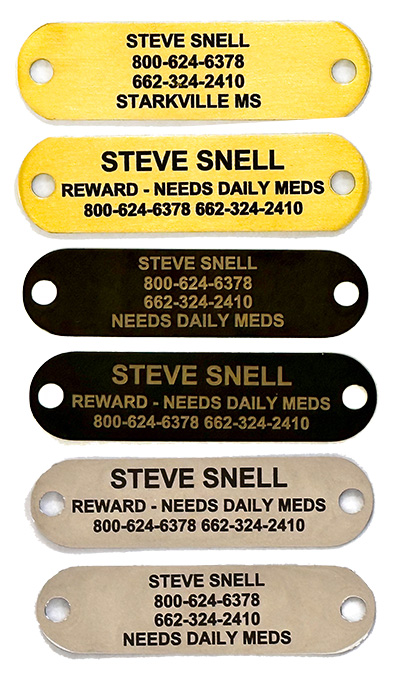 What Info to Put On Your Dog TagsYou've got 3–4 lines. Less than 100 characters. Here's how to spend them. Cell Phone Numbers — Two of Them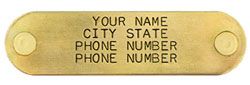
I want two cell phone numbers. Not one. Two. Here's the problem with one number: the situations most likely to cause your dog to get loose are the same situations most likely to put your phone out of reach. You're in the field and out of service. You're dealing with the emergency that caused the dog to bolt. Or — and this is the one people don't like to think about — something happened to you. I had a friend who was in a car wreck and didn't survive it. Her dog got out. Dogs in vehicle accidents get freaked out and run. If that's the only number on the tag and the owner can't answer, the tag doesn't help. That second number isn't paranoia — it's just thinking it through. My tags have my cell number and my wife Kathy's. But even that has a weakness — if we're traveling together, which we often are, both phones are in the same truck. I also put my office number, and I've got hunting buddies whose numbers I'd trust. The point is: find a second responsible party whose number belongs on your dog. One important thing about that second number: pick someone who answers calls from numbers they don't recognize. Spam calls have trained a lot of people to ignore unknowns. If both your numbers belong to people who do that, the tag is only half as useful. My brother is a lost cause on this front — I'll say that out loud. You know who in your life picks up the phone. Put their number on the tag. Your vet's number is also worth considering. If somebody finds your dog and can't reach you, they can take the dog straight to the vet — who already knows you, knows the dog, and can hold her until you're reachable. Please ask them before you do this. Your NamePut it on there. When my son had Cowboy and the dog got found, the caller said the tag had Steve Snell on it. Sam said, "That's my dad's dog." Name on the tag traces the dog back to a person, not just a phone number. City and StateI travel constantly with dogs. If I'm in Texas and the tag says Starkville, Mississippi, it's obvious the dog is a long way from home and someone is actively looking. City and state tells the story quickly. Address is secondary — if I'm moving around a lot, an address goes stale. City and state doesn't. Zip code: skip it. The person who found your dog doesn't need it, and it takes up line space. A Call to Action"Reward" works. I've offered it for years. I don't think I've ever actually paid one — people almost always refuse. But the word signals intent. This dog matters. Call now. "Requires daily medication" has been on our family's tags since my father started doing it in the eighties, when we were running dogs on Filaribits — a daily heartworm preventative where missing a dose was genuinely dangerous. The medical situation has changed, but the phrase stays. It communicates urgency in a way "reward" alone doesn't. Get this dog home fast. My new favorite: FREE BEER UPON RETURN. It accomplishes everything a call to action should. It makes people smile, it makes the tag memorable, and it makes crystal clear that somebody wants that dog back. NOT Your Dog's Name and Here's WhyA lot of customers want their dog's name on the tag. I get it. But I don't put it on mine, and here's my reasoning. First, it takes up line space you probably need for a second phone number. Second, in parts of the country where dog theft is real — and it is real, especially for trained hunting dogs — knowing the dog's name makes it easier for someone to appear familiar to her. That said, I've also softened on this over the years. The argument that a thief needs your dog's name to steal her doesn't hold up as well as it used to. If someone wants to steal a well-trained bird dog, they're not waiting to find out her name first. Bottom line: your name and two phone numbers matter more than the dog's name. If there's room, add it. If there isn't, leave it off. Double TaggingIf you want to put a lot of information on your dog's collar — two phone numbers, a second contact, city and state, a call to action, your name — four lines fills up fast. We can put two ID plates on a collar. It's a small upcharge. My personal collars are all double tagged. I've got my cell, the office line, the 800 number, and a couple of call-to-actions. If you want simple, name and two cell numbers fits on one plate. If you want everything, double tag it. What About Microchips?Chip your dog. I recommend it. But understand what a chip is and what it isn't. A microchip is RFID — passive, no battery, no broadcast. It requires a scanner pressed directly against the dog to read it. Chips are great for vets and shelters. Any shelter or vet clinic is going to scan a found dog and your information will come up. And if someone steals your dog and you need to prove ownership, a chip is something law enforcement can verify. That matters. But a random person who finds your dog in a field, on a highway, or in their backyard is not going to have a scanner. They're going to look at the collar. Tag wins in that situation every time. Chip your dog and tag your dog. They're not the same tool. The Bottom LineDog tags are the most important thing we sell. I say that knowing we sell GPS systems and tracking collars and all the rest of it. None of that replaces this. The tag is the recovery device that requires no battery, no signal, no subscription, and no equipment on the part of the person who finds your dog. It just requires a phone call. Put your phone number on your dog. Two numbers. Make sure at least one of them belongs to someone who answers. And if you want to offer free beer to whoever brings her back — I think that's a great call.  Shop Dog ID Tags at Gun Dog Supply → |




FREE SHIPPING on Orders $125+ |
 |  |  |
You New Here? See 9 reasons why you should shop here.