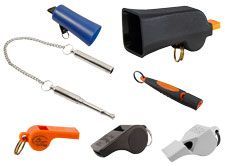
 Dog Whistle Buyer's Guide by Steve SnellBasic Features of the Dog Training WhistlesWe sell the 3 major brands of whistles: All three brands are high-quality products and come in many different styles and designs.
What a Dog Whistle Will NOT DoThe whistles we sell are for training dogs. They are used to issue commands and get your dog's attention.Silent Whistles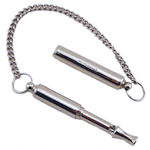 "Silent" Whistles work just like any other whistles -- you blow through them and they make a noise. It is called a "silent whistle" because it operates on a frequency above that of the average person's hearing. You will hear something, but not much. A few people can hear the actual tone, but most folks just hear the sound of the air going through the whistle. "Silent" Whistles work just like any other whistles -- you blow through them and they make a noise. It is called a "silent whistle" because it operates on a frequency above that of the average person's hearing. You will hear something, but not much. A few people can hear the actual tone, but most folks just hear the sound of the air going through the whistle.The idea behind this type of whistle is that it will not disturb anyone standing right there with you. Dog's hearing goes further into the ultrasonic range than people's so they can hear these whistles. In other words, it is very LOUD to dogs but very QUIET to people. The whistles are tunable so that you can tune it to a frequency that gets the most response from your dog. The Acme Silent Dog Whistle produces ultra high frequencies in the range of 5800 Hz to 12,400 Hz. You can read more about it and even hear a sample here. The silent whistle has the longest range of the whistles we carry. SportDOG Roy Gonia Whistles and MEGA Whistles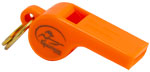 Roy Gonia whistles have been the standard in Retriever Training for the last 30 years. We recommend the Roy Gonia Special Whistle for use with young pups and for short-distance training, as it is lower-pitched and not as loud as the other whistles. Roy Gonia whistles have been the standard in Retriever Training for the last 30 years. We recommend the Roy Gonia Special Whistle for use with young pups and for short-distance training, as it is lower-pitched and not as loud as the other whistles.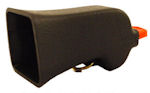 The Roy Gonia Mega Whistle has a plastic megaphone that is attached to the regular Gonia whistle. What the mega does is push the sound away from the handler and out toward the dog. These are very loud whistles, but they are easier on your ears because of the design. The Roy Gonia Mega Whistle has a plastic megaphone that is attached to the regular Gonia whistle. What the mega does is push the sound away from the handler and out toward the dog. These are very loud whistles, but they are easier on your ears because of the design.Fox 40 Whistles for Dog Training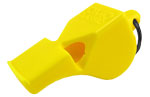 The Fox 40 Classic Whistle is designed to be heard above all kinds of noise including breaking waves and thundering gale-force winds. The Fox 40 Classic's chambers are designed to self-clear when submerged in water. The Fox 40 Classic is a pealess design and has no moving parts to freeze or jam. It is an easy to blow, super loud whistle. The Fox 40 Classic Whistle is designed to be heard above all kinds of noise including breaking waves and thundering gale-force winds. The Fox 40 Classic's chambers are designed to self-clear when submerged in water. The Fox 40 Classic is a pealess design and has no moving parts to freeze or jam. It is an easy to blow, super loud whistle.Acme Thunderer and Oblong Whistles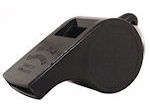 Acme Whistles have been made in England since the late 1800s. They are the oldest whistle company in the world. Acme has pioneered the majority of whistle manufacturing techniques used today. Acme Whistles have been made in England since the late 1800s. They are the oldest whistle company in the world. Acme has pioneered the majority of whistle manufacturing techniques used today.The Acme Thunderer is our number one pointing dog whistle. I grew up using the plastic 558 and 559 as my main training whistles. The Acme Thunderer Metal Whistles are also staples in the bird dog world. 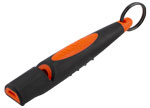 Acme Oblong Whistles are a favorite of close working retriever trainers and flushing dog owners. These whistles are very easy on the handler's ears and are popular in situations when you don't need extreme volume. Acme Oblong Whistles are a favorite of close working retriever trainers and flushing dog owners. These whistles are very easy on the handler's ears and are popular in situations when you don't need extreme volume.How to Train With a WhistleA pretty common misunderstanding by the general public is that dogs will automatically respond to a whistle with no training. A dog that knows his verbal commands will usually pick up whistle signals very quickly.If your dog will not obey your verbal commands, there is no reason to think he will obey whistle commands. Without training, these whistles are like any other noise to your dog. A whistle command is a cue just like a verbal command. Whistle training is achieved by overlaying the whistle command once the verbal command is mastered. The first thing you need to do is pick out a standard set of whistle commands. While you can train pretty much any command with a whistle, the normal ones are a recall or "here" command, "sit," and a "change direction" or turn command. The main whistle command in retriever work is the "Sit" whistle, which is normally one quick blast. The here or recall whistle can be three or four quick blasts in rapid succession. I use a long trill for a turn whistle. My field dogs are trained to look at me after the turn command is given, so I can give a hand signal for the correct direction if needed. Just like verbal commands, it really does not matter which whistle commands you use, but you must be consistent in your commands. Training with a whistle is just like regular vocal commands, but after the dog learns the command, you add the whistle command after the verbal command. Let's start with the Sit whistle (one quick blast). You need a dog that has mastered both "heel" and "sit" verbal commands. Start your dog out on a leash in the heel position. As you walk along, give the verbal command "Sit" and then immediately blow the whistle. Your dog will sit. Give him verbal praise. Repeat this over and over: verbal command followed by the whistle command. After you have done a certain amount of this, start to drop the verbal command. Only give the verbal command every other time. Once you can see the dog understanding just the whistle command, you can stop giving the verbal. The same idea applies to all other commands. You will need to have different whistle combinations for every command so that the dog understands which one you want him to do. We always teach commands on a long line or check cord so we have physical control over the dog and can make him do what he needs to complete the command. I don't recommend that most folks teach more than two or three whistle commands. Keep them simple and make sure your dog understands the command before you add the next one. |




FREE SHIPPING on Orders $125+ |
 |  |  |